Is Huawei H12-811_V2.0 Questions–Best Way To Clear The Exam?
Wiki Article
It never needs an internet connection. Huawei HCIA-Datacom V2.0 practice exam software has several mock exams, designed just like the real exam. Huawei H12-811_V2.0 Practice Exam software contains all the important questions which have a greater chance of appearing in the final exam. SureTorrent always tries to ensure that you are provided with the most updated HCIA-Datacom V2.0 Exam Questions to pass the exam on the first attempt.
You must want to receive our H12-811_V2.0 practice questions at the first time after payment. Don’t worry. As long as you finish your payment, our online workers will handle your orders of the H12-811_V2.0 study materials quickly. The whole payment process lasts a few seconds. And if you haven't received our H12-811_V2.0 Exam Braindumps in time or there are some trouble in opening or downloading the file, you can contact us right away, and our technicals will help you solve it in the first time.
>> H12-811_V2.0 Original Questions <<
Free PDF Quiz 2026 Huawei H12-811_V2.0: HCIA-Datacom V2.0 – The Best Original Questions
Our delivery speed is also highly praised by customers. Our H12-811_V2.0 exam dumps won’t let you wait for such a long time. As long as you pay at our platform, we will deliver the relevant H12-811_V2.0 test prep to your mailbox within 5-10 minutes. Our company attaches great importance to overall services, if there is any problem about the delivery of H12-811_V2.0 Test Braindumps, please let us know, a message or an email will be available. We are pleased that you can spare some time to have a look for your reference about our H12-811_V2.0 test prep.
Huawei H12-811_V2.0 Exam Syllabus Topics:
| Topic | Details |
|---|---|
| Topic 1 |
|
| Topic 2 |
|
| Topic 3 |
|
| Topic 4 |
|
| Topic 5 |
|
Huawei HCIA-Datacom V2.0 Sample Questions (Q16-Q21):
NEW QUESTION # 16
When a Huawei network device functions as an FTP server, which of the following are possible causes of an FTP client failing to log in to the FTP server? (Select all that apply)
- A. The authorized directory is not specified for FTP users.
- B. The network between the device and the FTP client is unreachable.
- C. The FTP user name and password are not configured.
- D. The FTP server function is not enabled on the device.
Answer: A,B,C,D
Explanation:
All four options are possible causes of FTP login failure, so the correct answer is A, B, C, and D.
Option A is correct because if the FTP server function is not enabled on the Huawei device, the device cannot provide FTP services and the client cannot log in. Option B is also correct because if the authorized directory is not specified for the FTP user, the user may not be able to complete login or access file services properly, depending on the FTP user configuration requirements. Option C is correct because an FTP user account must be configured with the required username and password; otherwise, authentication cannot succeed. Option D is also correct because if the network between the FTP client and the device is unreachable, the client cannot establish the FTP connection at all.
In HCIA-Datacom troubleshooting, FTP login failure is usually checked from four aspects: service enablement, user configuration, permission or directory authorization, and network connectivity. This question tests standard remote maintenance troubleshooting logic for file transfer services on Huawei network devices.
NEW QUESTION # 17
IEEE 802.11 is the standard for WLANs. Which of the following 802.11 protocols uses 1024-QAM modulation?
- A. 802.11ax
- B. 802.11ac
- C. 802.11be
- D. 802.11n
Answer: B
Explanation:
The correct answer is 802.11ac , so option C is correct. In standard WLAN evolution knowledge used in HCIA-Datacom, 802.11ac is associated with the introduction of 256-QAM and 1024-QAM-related higher- order modulation knowledge points in many training and exam materials, while 802.11ax and 802.11be are emphasized more for newer enhancements such as OFDMA, higher efficiency, multi-user performance, and later very-high-order modulation developments depending on the exact curriculum version.
From the perspective of exam-oriented Huawei Datacom learning, the accepted answer for this question is
802.11ac . Option A , 802.11n, is earlier-generation Wi-Fi and does not use 1024-QAM as the defining answer here. Option B , 802.11ax, is Wi-Fi 6 and introduces major efficiency improvements, but this question' s expected answer set identifies 802.11ac . Option D , 802.11be, corresponds to Wi-Fi 7 and is associated with even more advanced capabilities in newer standards. HCIA-Datacom WLAN questions often test the matching of a standard with one representative technical characteristic from the training materials rather than the entire modulation evolution history.
NEW QUESTION # 18
In the STP topology shown in the figure, all links have the same path cost, and SW1 is the root bridge. Which of the following ports will become designated ports? (Select all that apply)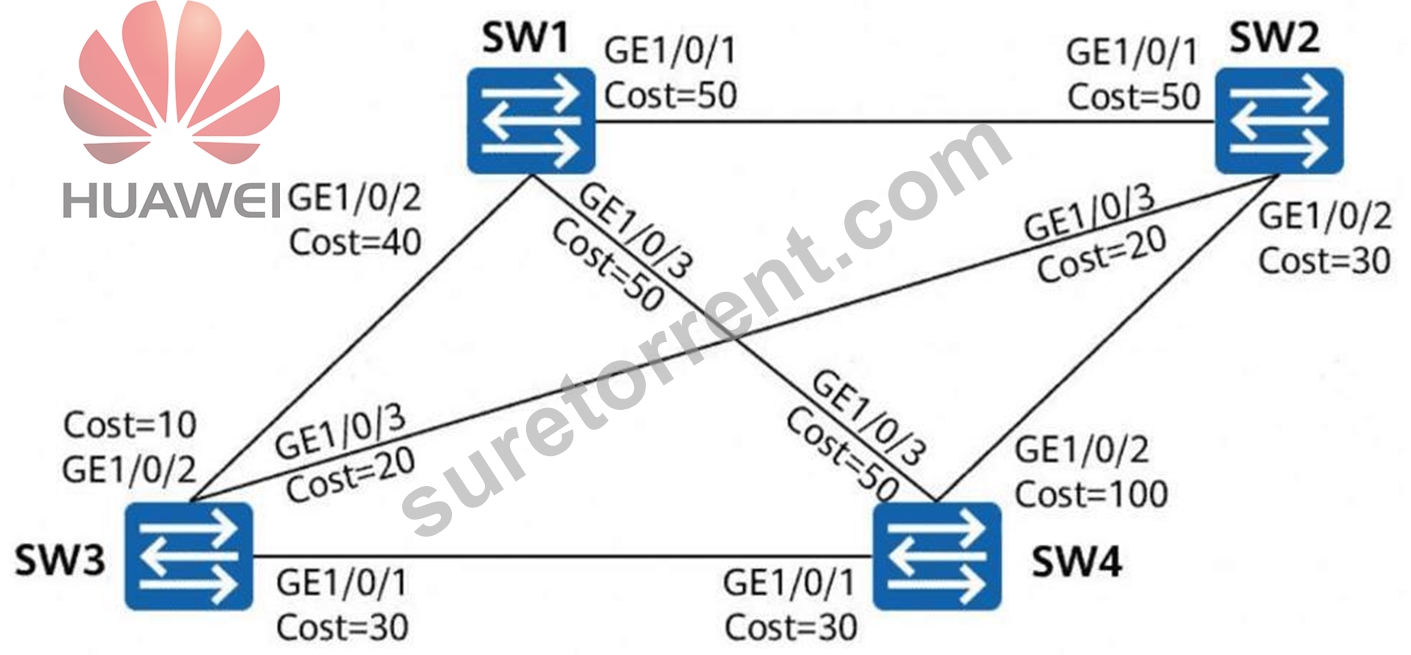
- A. GE1/0/3 of SW3
- B. GE1/0/1 of SW4
- C. GE1/0/1 of SW2
- D. GE1/0/2 of SW2
Answer: A,C,D
Explanation:
In STP, the root bridge has all its active ports elected as designated ports on each connected segment. On non-root switches, one port is selected as the root port , and on each LAN segment, one designated port is elected based on the best BPDU. Since SW1 is the root bridge and all links have equal cost, the election depends first on the path cost to the root, then on bridge ID, and then on port ID if needed.
According to the topology, the ports that become designated are GE1/0/2 of SW2 , GE1/0/1 of SW2 , and GE1/0/3 of SW3 , which correspond to option A , B , and C . Option D is not a designated port in this topology because that segment has another port with a superior BPDU and therefore SW4's port does not win the designated-port election. HCIA-Datacom emphasizes that designated ports are elected per segment , not per switch, and that every non-root switch must compare received BPDUs to determine root and designated roles. This question tests the ability to apply STP election logic rather than simply memorizing port-role definitions.
NEW QUESTION # 19
Assume that the IP address of GE0/0/0 on R1 is 10.0.12.1/24. Multiple commands can be used to enable OSPF on this interface. Match the commands with their configuration views.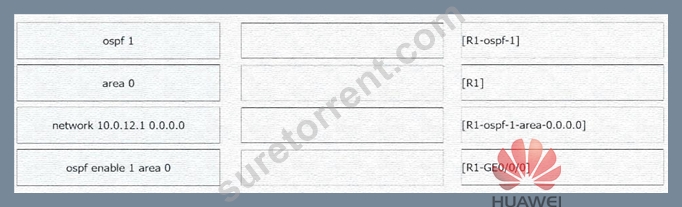
Answer:
Explanation: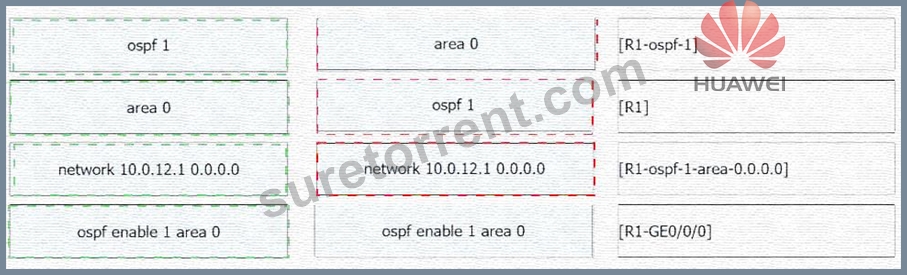
Explanation:
ospf 1 # [R1]
area 0 # [R1-ospf-1]
network 10.0.12.1 0.0.0.0 # [R1-ospf-1-area-0.0.0.0]
ospf enable 1 area 0 # [R1-GE0/0/0]
Huawei devices support two common ways to enable OSPF on an interface.
The first method is the process-based method . In this method, you first enter system view, then enter the OSPF process view using ospf 1, so this command belongs to [R1] . After that, you enter the area view using area 0, so this command belongs to [R1-ospf-1] . Inside the area view, the command network 10.0.12.1
0.0.0.0 is used to match the interface with IP address 10.0.12.1, so it belongs to [R1-ospf-1-area-0.0.0.0] .
The second method is the interface-based method . In this method, OSPF is enabled directly under the interface using ospf enable 1 area 0, so this command belongs to [R1-GE0/0/0] .
This question tests the difference between global OSPF process configuration and direct interface OSPF enabling , both of which are standard Huawei OSPF configuration methods.
NEW QUESTION # 20
In the leader AP networking architecture, the leader AP functions as a WAC and uses the CAPWAP protocol to uniformly manage and configure Fit APs.
- A. TRUE
- B. FALSE
Answer: A
Explanation:
This statement is true . In the leader AP networking architecture, one AP acts as the leader AP , taking on controller-like functions similar to those of a WAC for a small or medium-sized WLAN deployment. It can centrally manage other Fit APs and deliver unified wireless configurations such as SSIDs, security settings, and radio parameters. CAPWAP is used for management and control communication between the leader AP and the managed Fit APs.
This architecture is useful in scenarios where deploying a dedicated WAC is unnecessary or uneconomical, but centralized AP management is still desired. It provides a balance between simplicity and control and is commonly used in branch offices, small campuses, and similar environments. HCIA-Datacom explains leader AP networking as an intermediate solution between fully autonomous AP deployment and full WAC + Fit AP enterprise architecture. The key point is that the leader AP behaves as the management node for the other APs and enables unified configuration and control. Therefore, the statement correctly describes both the role of the leader AP and the use of CAPWAP in this architecture.
NEW QUESTION # 21
......
Our H12-811_V2.0 study materials boost high passing rate ss more than 98% and hit rate so that you needn't worry that you can't pass the test too much. We provide free tryout before the purchase to let you decide whether it is valuable or not by yourself. To further understand the merits and features of our H12-811_V2.0 Practice Engine you could free download the free demo of our H12-811_V2.0 exam questions, or visit our web page to know more related information. And you can pass your H12-811_V2.0 exam with the least time and energy with our wonderful H12-811_V2.0 exam questions.
H12-811_V2.0 Valuable Feedback: https://www.suretorrent.com/H12-811_V2.0-exam-guide-torrent.html
- Huawei H12-811_V2.0 Dumps PDF To Gain Brilliant Result 2026 ???? Easily obtain ⏩ H12-811_V2.0 ⏪ for free download through ⇛ www.exam4labs.com ⇚ ????Reliable H12-811_V2.0 Test Duration
- H12-811_V2.0 Reliable Braindumps Free ❎ H12-811_V2.0 Reliable Braindumps Free ???? H12-811_V2.0 Exam Tests ???? Open website ☀ www.pdfvce.com ️☀️ and search for ✔ H12-811_V2.0 ️✔️ for free download ????Valid H12-811_V2.0 Exam Camp
- Valid H12-811_V2.0 Exam Camp ???? H12-811_V2.0 Official Practice Test ???? Authorized H12-811_V2.0 Pdf ???? Search for ✔ H12-811_V2.0 ️✔️ and download it for free immediately on ➽ www.verifieddumps.com ???? ????Relevant H12-811_V2.0 Answers
- Passing H12-811_V2.0 Score ⚪ Certification H12-811_V2.0 Sample Questions ???? H12-811_V2.0 Reliable Dump ⏩ Search on ▷ www.pdfvce.com ◁ for “ H12-811_V2.0 ” to obtain exam materials for free download ????Relevant H12-811_V2.0 Answers
- H12-811_V2.0 Official Practice Test ???? Authorized H12-811_V2.0 Pdf ???? H12-811_V2.0 Excellect Pass Rate ???? Copy URL [ www.vce4dumps.com ] open and search for ⇛ H12-811_V2.0 ⇚ to download for free ????H12-811_V2.0 Latest Test Cram
- H12-811_V2.0 Preparation Materials and Study Guide: HCIA-Datacom V2.0 - Pdfvce ???? Search on ➽ www.pdfvce.com ???? for ▷ H12-811_V2.0 ◁ to obtain exam materials for free download ????Cert H12-811_V2.0 Exam
- H12-811_V2.0 Reliable Braindumps Free ???? Relevant H12-811_V2.0 Answers ???? H12-811_V2.0 Reliable Practice Questions ???? Search for ➽ H12-811_V2.0 ???? and obtain a free download on ⇛ www.exam4labs.com ⇚ ????Certification H12-811_V2.0 Sample Questions
- Study Materials H12-811_V2.0 Review ???? H12-811_V2.0 Reliable Braindumps Free ⛴ H12-811_V2.0 Test Cram Review ???? Immediately open 【 www.pdfvce.com 】 and search for 【 H12-811_V2.0 】 to obtain a free download ⛑H12-811_V2.0 Reliable Dump
- New H12-811_V2.0 Original Questions 100% Pass | Efficient H12-811_V2.0: HCIA-Datacom V2.0 100% Pass ???? Open ➠ www.vce4dumps.com ???? and search for 「 H12-811_V2.0 」 to download exam materials for free ????Reliable H12-811_V2.0 Test Duration
- Cert H12-811_V2.0 Exam ⛪ H12-811_V2.0 Reliable Practice Questions ???? Relevant H12-811_V2.0 Answers ♻ Copy URL ➽ www.pdfvce.com ???? open and search for ⮆ H12-811_V2.0 ⮄ to download for free ????Relevant H12-811_V2.0 Answers
- Huawei H12-811_V2.0 Dumps PDF To Gain Brilliant Result 2026 ???? Search for ( H12-811_V2.0 ) and easily obtain a free download on ➠ www.examcollectionpass.com ???? ????H12-811_V2.0 Exam Tests
- jaywxbq616399.buyoutblog.com, jayfpsr236786.blogproducer.com, emiliadjmz579508.snack-blog.com, zoeqsdv465733.nico-wiki.com, graysonzier658872.bloggadores.com, minibookmarking.com, sairadpat838499.blogproducer.com, blogingwala.com, blanchewyis193973.wikiparticularization.com, echobookmarks.com, Disposable vapes